The Quiet Logic of a Weekend Loaf
A simple loaf becomes easier when the recipe is treated as a sequence of pauses rather than a race against the clock.
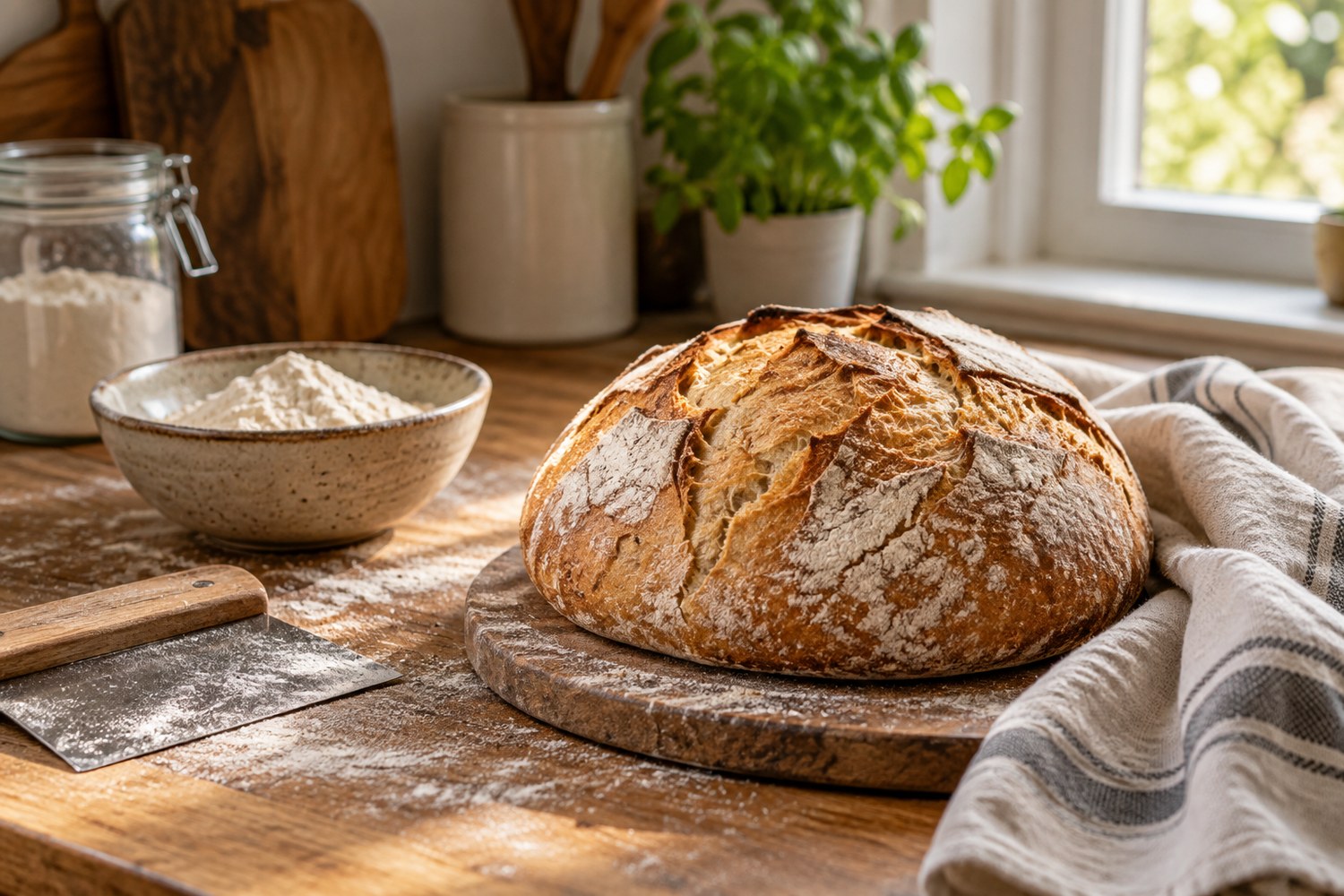
Bread looks busy from the outside. There is flour on the counter, a bowl to scrape, a loaf to shape and an oven that needs to be hot at exactly the right moment. Yet most of the work in a good weekend loaf is waiting. The dough needs time to hydrate, time to ferment, time to relax after shaping and time to cool before the first slice.
Once that is understood, baking becomes less like a project that occupies the kitchen and more like a rhythm that runs quietly beside the rest of the day.
Begin with the clock, not the bowl
The easiest way to make bread fit into a weekend is to decide when you want to eat it. Work backward from there. If you want a loaf for Sunday lunch, the dough might be mixed on Saturday afternoon, folded a few times while dinner is being prepared, then shaped and refrigerated overnight. The cold rest is useful not because it is sophisticated, but because it moves the most unpredictable part of fermentation into a slower window.
This changes the mood completely. Instead of checking the dough every ten minutes, you can read, go for a walk or leave the kitchen alone. Bread improves when the baker is willing to stop touching it.
A short list of tools is enough
You do not need a drawer full of specialist equipment. A digital scale helps with consistency. A large bowl gives the dough room to rise. A flexible scraper keeps flour from spreading across the whole worktop. A sharp knife or razor makes scoring easier. A heavy covered pot is useful for a crisp crust, but a preheated tray and a little steam can also make a very good loaf.
Most of the refinement comes from repetition rather than gear. After a few bakes, you begin to recognize when dough feels too tight, when it has enough strength to hold shape, and when a warm kitchen is moving faster than the recipe suggests.
Watch the dough, then check the recipe
Recipes need numbers, but dough lives in a room. Flour absorbs water differently from bag to bag. Summer kitchens ferment faster than winter ones. A starter or yeast mixture can be unusually active one week and slow the next. The instructions give you a route; the dough tells you where you actually are.
Look for volume rather than a perfect timer. Feel for elasticity. During the first rise, the surface should become smoother and slightly domed. When you lift an edge, it should stretch with some resistance rather than tear immediately. These are small observations, but they are more transferable than memorizing a single schedule.
Shaping is the moment when many home bakers become tense, because the loaf suddenly looks as if it ought to be perfect. It does not. The goal is simply to create enough surface tension for the dough to hold itself upright. A slightly uneven seam or an off-center score will still become bread.
The oven does the dramatic part
The first twenty minutes of baking are the most theatrical: the loaf expands, the score opens and the crust begins to set. Then the work becomes quieter again. Color deepens. Moisture leaves the interior. The kitchen fills with that unmistakable toasted smell that makes patience much harder.
Cooling is part of the bake, even though it feels unfair. Cut too early and steam escapes before the crumb has finished setting. Wait an hour and the loaf will slice more cleanly, with a texture that shows what fermentation and heat actually accomplished.
A weekend loaf is satisfying because it turns time into an ingredient you can see. Flour and water begin as a sticky mass; a few hours later they have structure, scent and a crust that crackles as it cools. The process asks for attention, but not constant attention. That balance is what makes it easy to return to.